
Certificate of Marriageability in India under the Special Marriage Act, 1954

Everything You Need to Know
When an Indian citizen plans to marry a foreign national or intends to get married in another country, one of the documents that is often requested by foreign authorities is a Certificate of Marriageability. Depending on the country, this document may also be referred to as a Single Status Certificate, Certificate of No Impediment (CNI), or Certificate of Freedom to Marry.
Despite its common use, many people assume that this certificate is issued under the Special Marriage Act, 1954. The legal position is quite different.
This guide explains what a Certificate of Marriageability is, whether it is recognised under Indian law, and how it can generally be obtained.
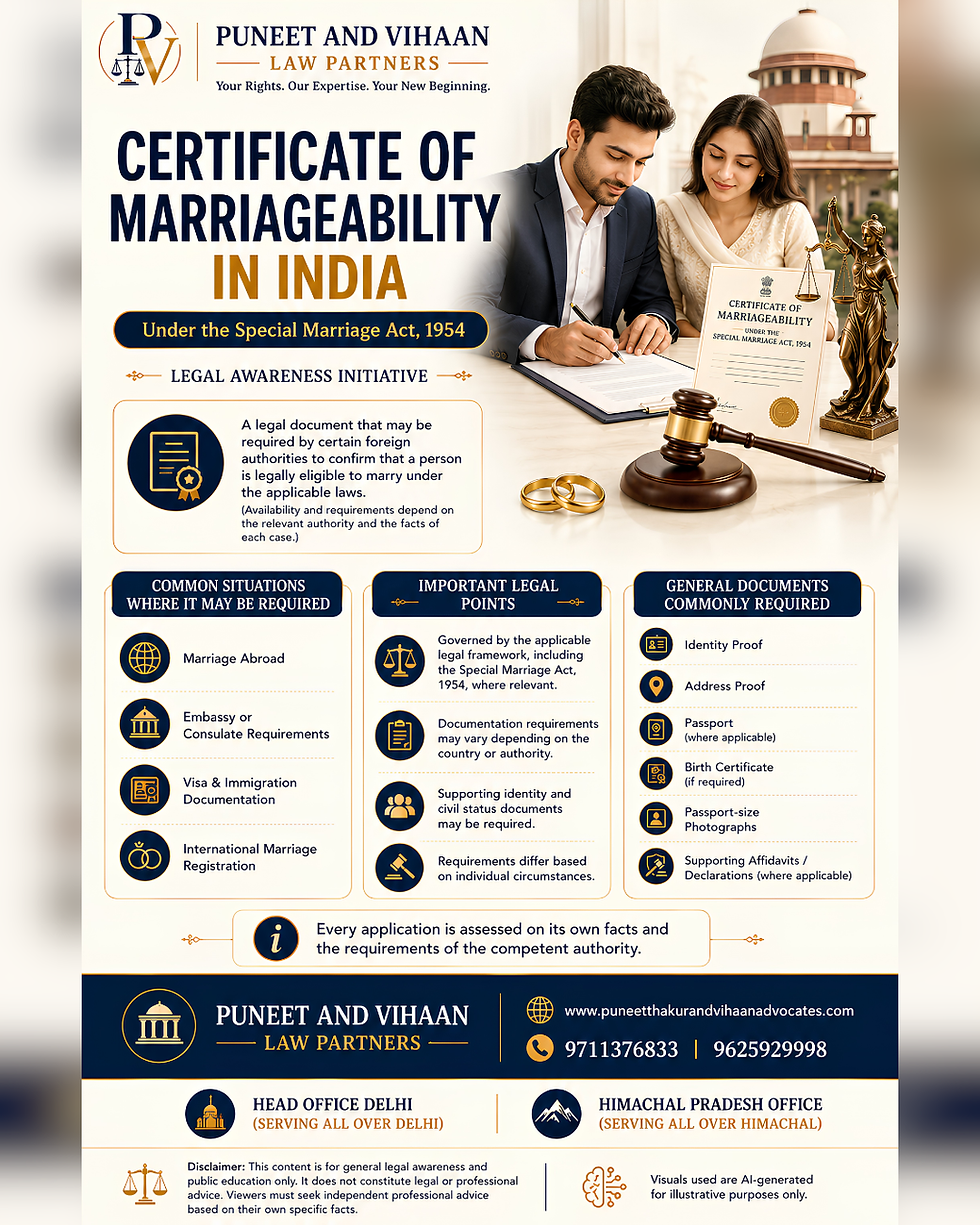
What Is a Certificate of Marriageability?
A Certificate of Marriageability is an official document or certification confirming that a person is legally eligible to marry. Its primary purpose is to assure foreign authorities that there is no legal obstacle preventing the applicant from entering into a valid marriage.
Typically, the certificate confirms that the individual:
Is unmarried, legally divorced, or widowed.
Has attained the legally prescribed age for marriage.
Has the legal capacity to marry.
Does not have a living spouse.
Is not disqualified from marrying under the applicable laws.
Since marriage laws differ across countries, many foreign governments insist on this document before permitting an Indian citizen to marry within their jurisdiction.
Does the Special Marriage Act, 1954 Provide for a Certificate of Marriageability?
No.
The Special Marriage Act, 1954 does not specifically provide for the issuance of a Certificate of Marriageability or a Certificate of No Impediment.
Instead, the Act establishes the legal framework for civil marriages in India by prescribing:
Eligibility conditions for marriage.
Filing of a Notice of Intended Marriage.
Publication of the notice.
Consideration of objections, if any.
Solemnization before the Marriage Officer.
Registration of the marriage.
Issuance of the statutory Marriage Certificate after the marriage has been solemnized.
Therefore, while the Act recognises and provides for a Marriage Certificate, it does not create a separate legal mechanism for issuing a pre-marriage Certificate of Marriageability.
Why Is a Certificate of Marriageability Required?
Although it is generally not required for marriages taking place entirely within India, this certificate becomes important in several international situations.
It may be requested for:
Marriage with a foreign national.
Marriage to be solemnized outside India.
Immigration or spouse visa applications.
Registration of marriage in another country.
Compliance with embassy or consular requirements.
Each country follows its own legal procedures, so documentary requirements may differ significantly.
Here’s the Legal Conditions for Marriage under the Special Marriage Act
Before a marriage can be solemnized under the Special Marriage Act, certain statutory conditions must be satisfied.
These include:
Neither party should have a living spouse at the time of marriage.
Both individuals must be capable of giving free and valid consent.
Neither party should suffer from a mental condition that legally disqualifies them from marriage.
The groom must have completed 21 years of age.
The bride must have completed 18 years of age.
The parties must not fall within the prohibited degrees of relationship unless such marriage is permitted by a recognised custom.
These conditions determine whether a marriage can legally take place under the Act.
Documents Generally Required
Although there is no single nationwide procedure, authorities commonly ask applicants to provide supporting documents such as:
Passport
Aadhaar Card
Birth Certificate
Proof of Address
Passport-size photographs
Affidavit declaring marital status
Divorce decree, where applicable
Death certificate of former spouse, if applicable
Police verification, wherever required
Newspaper publication, if prescribed by the concerned authority
The exact list may vary depending upon the State Government, local administration, embassy, or the country where the marriage is proposed.
How Can a Certificate of Marriageability Be Obtained?
Since there is no uniform statutory process across India, the procedure usually depends on the administrative practice followed by the concerned State or authority.
In most cases, the process involves:
Step 1 – Preparing an Affidavit
The applicant executes an affidavit declaring his or her present marital status.
Step 2 – Submission of Supporting Documents
Identity proof, address proof, age proof, photographs, and other relevant documents are submitted for verification.
Step 3 – Verification by the Competent Authority
The concerned authority may verify the documents and the applicant's declared marital status.
Step 4 – Police Verification (Where Applicable)
Certain authorities may conduct police verification before processing the application.
Step 5 – Public Notice (If Required)
Some jurisdictions may require publication of a notice in local newspapers before issuing the certificate.
Step 6 – Issuance of Certificate
Upon successful verification, the competent authority may issue a Marriageability or Single Status Certificate, wherever such an administrative service is available.
Marriage Certificate vs. Certificate of Marriageability
Marriage Certificate | Certificate of Marriageability |
Issued after marriage | Issued before marriage |
Confirms that a valid marriage has already taken place | Mainly Confirms that a person is legally free to marry |
Expressly recognised under Section 13 of the Special Marriage Act | Not specifically recognised under the Special Marriage Act |
Serves as conclusive proof of marriage | Primarily used for international marriage formalities |
Marriage Certificate under Section 13 of the Special Marriage Act
After a marriage is solemnized under the Special Marriage Act, the Marriage Officer records the details in the Marriage Certificate Book.
Once signed by the parties and three witnesses, the Marriage Certificate becomes conclusive evidence that the marriage has been solemnized in accordance with law.
This statutory certificate should not be confused with a Certificate of Marriageability, which serves an entirely different purpose.
Can an Indian Embassy Issue a Certificate of Marriageability?
Generally, Indian Embassies and Consulates do not maintain official records regarding the marital status of Indian citizens.
Consequently, many diplomatic missions require applicants to first obtain appropriate supporting documents or a marital status certificate from the relevant authorities in India before extending any related consular assistance.
The exact requirements vary depending on the country concerned.
Position in Different States
There is currently no uniform law across India governing the issuance of Marriageability Certificates.
However, certain State Governments have introduced administrative mechanisms through their citizen service portals for issuing Marriageability or Single Status Certificates.
These services are created under State administrative rules and should not be treated as certificates issued under the Special Marriage Act, 1954.
Applicants should therefore verify the latest procedure applicable in their respective State.
Frequently Asked Questions (FAQs)
1. Is a Certificate of Marriageability compulsory in India?
No. It is generally required only when demanded by a foreign country, embassy, immigration authority, or overseas marriage registrar.
2. Does the Special Marriage Act provide for this certificate?
No. The Act provides only for the statutory Marriage Certificate issued after the marriage has been solemnized.
3. Can an unmarried Indian citizen obtain this certificate?
Yes. In States where such an administrative facility exists, eligible applicants may obtain the certificate after completing the prescribed verification process.
4. Is a notarized affidavit enough?
That depends on the destination country. Some foreign authorities accept a sworn affidavit, while others insist upon an official certificate issued by a government authority.
5. Is the procedure the same across India?
No. Since there is no central legislation governing the issuance of Marriageability Certificates, procedures differ from one State to another.
Conclusion
A Certificate of Marriageability plays a significant role for Indian citizens who intend to marry abroad or marry a foreign national. However, it is important to understand that this document is not a statutory certificate issued under the Special Marriage Act, 1954.
The Act governs the legal process for civil marriages and provides for the issuance of a Marriage Certificate only after the marriage has been solemnized. A Certificate of Marriageability, on the other hand, is generally an administrative document issued—where available—under State-level procedures or accepted through supporting declarations and verification.
Before applying, individuals should carefully verify the documentary requirements of the destination country and consult the relevant State authority, local administration, embassy, or Indian diplomatic mission to ensure compliance with the applicable legal formalities.


Comments